
 Donation


This joint initiative of CDRI and NSET aims to review and strengthen the Thimphu Earthquake Contingency Plan (TEQCP) and related sector-specific preparedness plans to assess their relevance, coherence, and operational readiness. Through structured document review and institutional coordination analysis, the project will identify key strengths, gaps, overlaps, and practical challenges in existing contingency planning. Simulation exercises will further test real-time preparedness, reveal operational gaps, and generate actionable lessons, contributing to stronger earthquake response systems and enhanced regional cooperation in seismic risk reduction.
OBJECTIVES
-
Review and strengthen the Thimphu Earthquake Contingency Plan (TEQCP) to make it practical, action‑oriented, and implementable.
-
Test and validate the TEQCP through multi‑agency earthquake simulation and tabletop exercises.
-
Improve inter‑agency coordination and emergency response readiness in Thimphu city.
-
Identify gaps and lessons learned from simulations and incorporate them into the updated TEQCP
Key Partner and Stakeholder:
Royal Government of Bhutan: Department of Local Government and Disaster Management (DLGDM)
Key Activities
-
Conduct initial and follow-up field visits to Bhutan
-
Undertake stakeholder consultations with government agencies and sector partners
-
Review and assess the existing Thimphu Earthquake Contingency Plan (TEQCP) and sector-specific plans
-
Carry out institutional mapping and capacity assessments
-
Assess critical infrastructure systems and their operational readiness
-
Identify infrastructure interdependencies and key vulnerabilities
-
Develop context-specific earthquake scenarios and risk models
-
Design the earthquake simulation and tabletop exercise (TTX) framework
-
Conduct pre-simulation orientations and training for participating agencies
-
Implement tabletop and pre-simulation exercises
-
Facilitate the full-scale, multi-agency earthquake TTX
-
Conduct After-Action Reviews (AARs) with stakeholders
-
Update and finalize the TEQCP based on simulation outcome
KEY HIGHLIGHTS
-
23 June 2026 – National-Level Earthquake Simulation Exercise (SIMEX), Thimphu, Bhutan
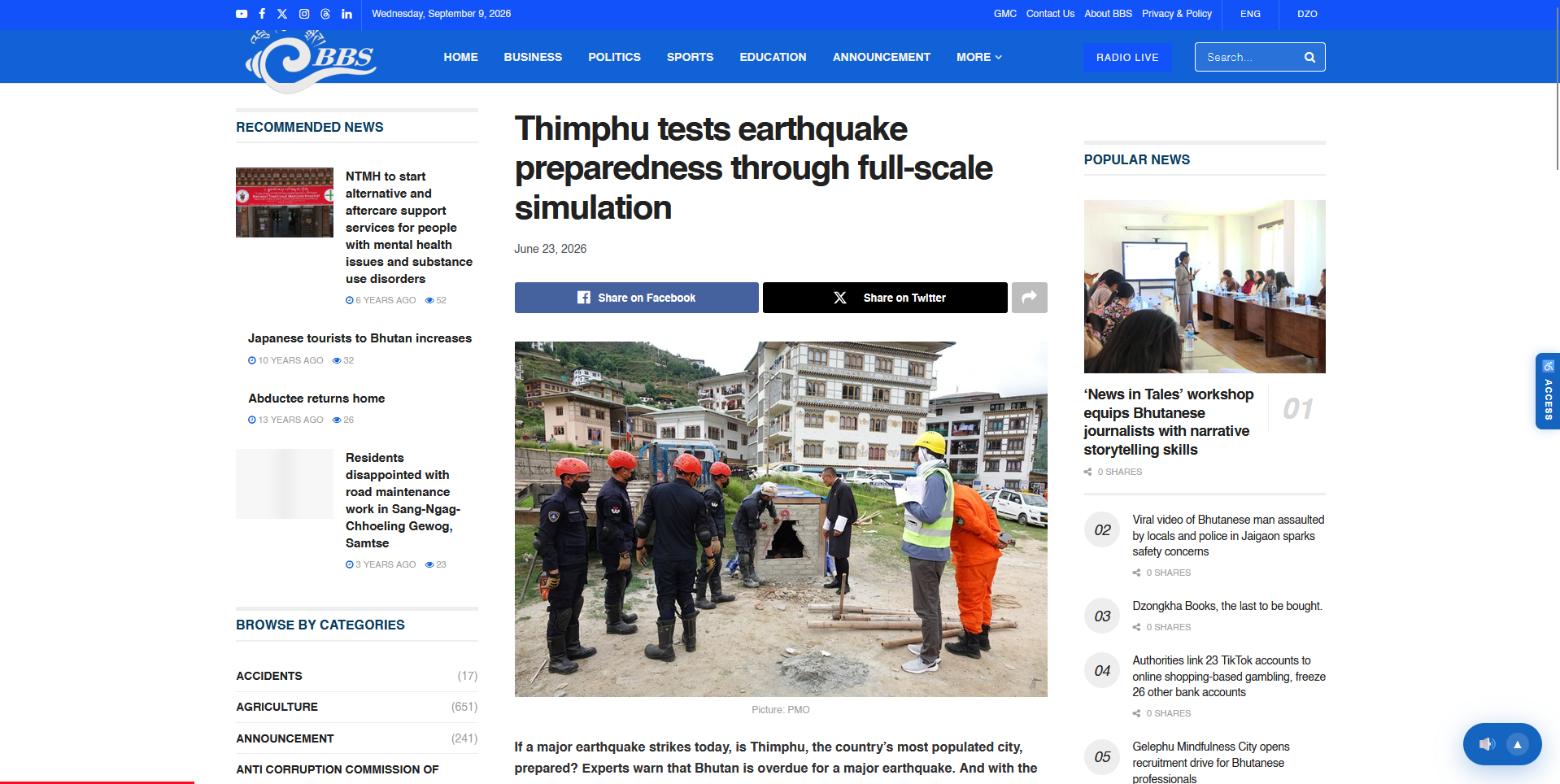
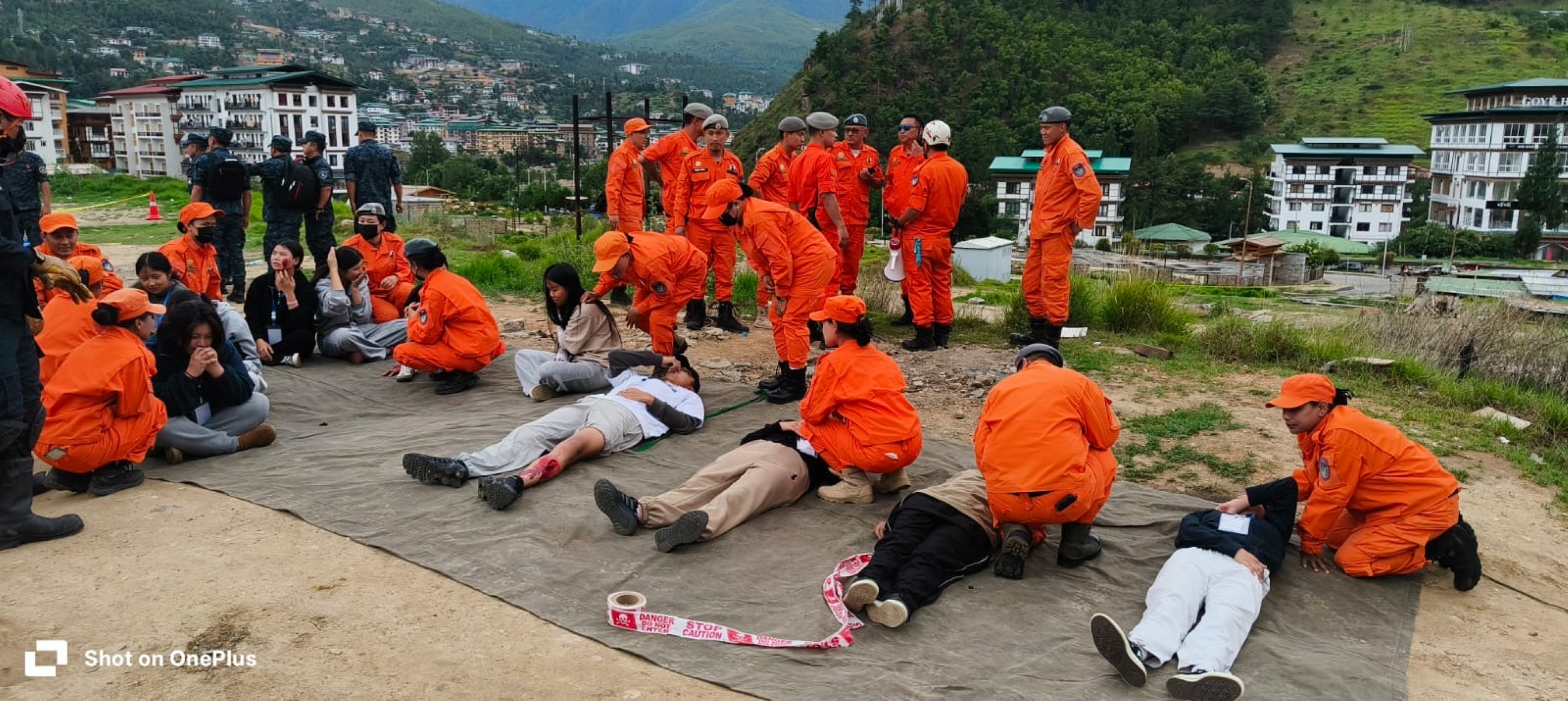
The full-scale exercise tested national earthquake preparedness, strengthened multi-agency coordination and emergency response mechanisms, engaged over 450 personnel from key stakeholder organizations, engaed 80+ Gyalsup volunteers as mock casualties using moulage techniques, and activated 14 functional response components across multiple locations to assess coordination, communication, and resource mobilization during a simulated major earthquake.
-
16 February 2026 – Tabletop Exercise (TTX) Simulation, Thimphu, Bhutan
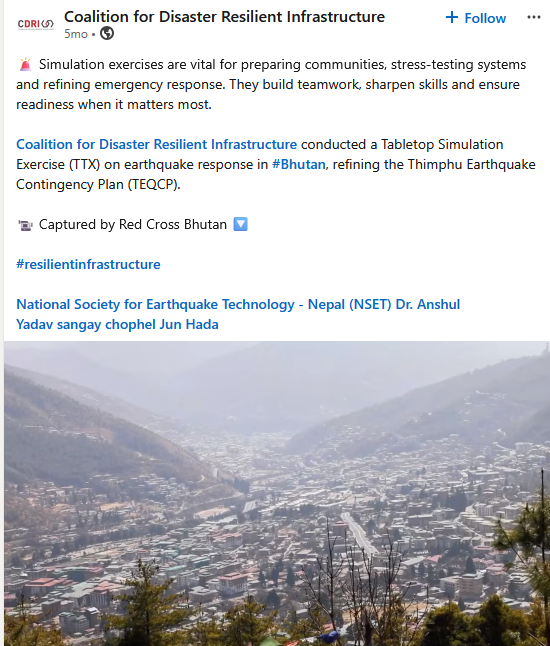
Tabletop Exercise (TTX) to test the Thimphu Earthquake Contingency Plan (TEQCP) was conducted. The exercise strengthened multi-sectoral coordination, clarified roles and responsibilities, identified operational gaps in emergency response, logistics, health services, and resource mobilization, and enhanced strategic decision-making during crisis situations. The simulation engaged over 130 participants, including senior government officials and technical agencies, and assessed national preparedness through a realistic earthquake scenario affecting urban areas in Bhutan.