

 Donation
| Date | Time | Latitude | Longitude | Magnitude(ML) | Remarks | Epicenter |
|---|---|---|---|---|---|---|
| Baisakh 12, 2072 | 25 April 2015 | 11:56(06:11 UTC) | 28.24 | 84.75 | 7.6 ML | NERMC/SC, DMG | Gorkha |
| Baisakh 12, 2072 | 25 April 2015 | 12:30(06:45 UTC) | 28.28 | 84.72 | 6.6 ML | NERMC/SC, DMG | Gorkha |
| Baisakh 29, 2072 | 12 May 2015 | 12:50(07:05 UTC) | 27.82 | 86.12 | 6.9 ML | NERMC/SC, DMG | Dolakha |
Gorkha Earthquake 2015
May 25, 2015
Background Nepal is the 11th most earthquake-prone country in the world.1 Ever since the first recorded earthquake of 1255 AD that killed one-third of the population of the Kathmandu Valley and its King, Abhaya Malla, Nepal has experienced a major earthquake every few generations. The last great earthquake (of magnitude 8.4) in 1934 AD resulted in more than 10,000 deaths in the Kathmandu Valley. Most of the infrastructure and major heritage sites had to be rebuilt. There have since been earthquakes causing severe human and physical loss in 1980, 1988 and 2011.
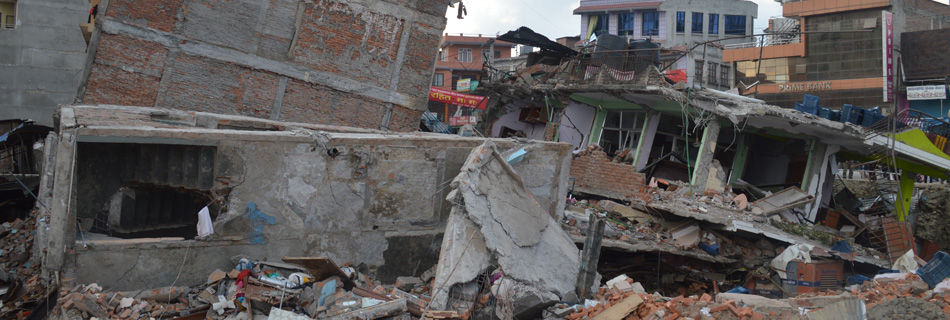
On Saturday, 25 April 2015 at 11:56 local time, a 7.6 magnitude earthquake as recorded by Nepal’s National Seismological Centre (NSC), struck Barpak in the historic district of Gorkha, about 76 km northwest of Kathmandu. Nepal had not faced a natural shock of comparable magnitude for over 80 years. The catastrophic earthquake was followed by more than 300 aftershocks greater than magnitude 4.0 (as of 7 June 2015). Four aftershocks were greater than magnitude 6.0, including one measuring 6.8 which struck 17 days after the first big one with the epicentre near Mount Everest.

To date, there are over 8,790 casualties and 22,300 injuries. It is estimated that the lives of eight million people, almost one-third of the population of Nepal, have been impacted by these earthquakes. Thirty-one of the country’s 75 districts have been affected, out of which 14 were declared ‘crisis-hit’ for the purpose of prioritizing rescue and relief operations; another 17 neighboring districts are partially affected.
The destruction was widespread covering residential and government buildings, heritage sites, schools and health posts, rural roads, bridges, water supply systems, agricultural land, trekking routes, hydropower plants and sports facilities. Hundreds of historical and cultural monuments at least a century old were either destroyed or extensively damaged. Over half a million houses were destroyed. The damage exposed the weaknesses of houses that did not have any seismic-resistant features or were not in accordance with the building codes. The disaster also highlighted aspects of inequities in Nepali society spanning geography, income and gender. Poorer rural areas have been more adversely affected than towns and cities due to their inferior quality of houses. More women and girls died than men and boys, partly because of gendered roles that disproportionately assign indoor chores to women. The time and day the first earthquake were experienced saved thousands of lives. Being a Saturday, the weekly holiday, schools across Nepal were closed on 25 April. The death toll of young people could have been much higher considering that nearly 7,000 schools were completely or significantly damaged. Similarly, if the earthquake had struck at night, and not in the middle of the day, there would certainly have been greater casualties.
What We Did
- Conducted detailed damage assessments of buildings across 14 earthquake-affected districts. Engaged and oriented with more than 300 engineers in post-earthquake assessments.
- Provided technical support to the National Reconstruction Authority (NRA) for recovery and reconstruction.
- Contributed as part of the reconnaissance study team to earthquake reconnaissance studies across earthquake-affected districts, in collaboration with EERI (Earthquake Engineering Research Institute).
- With USAID funding, implemented the Housing Reconstruction Technical Assistance Project “Baliyo Ghar Program” five-year in four earthquake-affected districts, supporting safer and more resilient housing reconstruction.
- Supported and strengthened building code implementation across 51 municipalities in Nepal, promoting safer and more resilient construction.
- Through the USAID-funded Program for Enhancement of Emergency Response (PEER), NSET supported the training the personnel from the Nepal Army, Nepal Police, and Armed Police Force in Search and Rescue (SAR), Structural and/or Urban Search and Rescue (SWR), Medical First Response (MFR), Collapsed Structure Search and Rescue (CSSR), and other emergency response skills, strengthening their capacity to respond effectively to disasters. Trained security personnel were mobilized during earthquake response operations, while the PEER training course was institutionalized to ensure sustained capacity development and preparedness.
Impact
- 8,702
- Deaths
- 22,303
- Injured
- 498,852
- Private House Destroyed
- 256,697
- Private House Partially Damaged
- Affected District
- 14 Crisis Hit and 17 Partially affected
- Total Damage & Losses
- NPR 706.5 Bn (US$ 7 billion)
- ~8 million
- People Affected
Affected
The Government reports that 35 of 75 districts are affected in the Western and Central Regions, including the Kathmandu Valley districts. People are also reported to have been badly affected in neighboring China and India.

