

 Donation
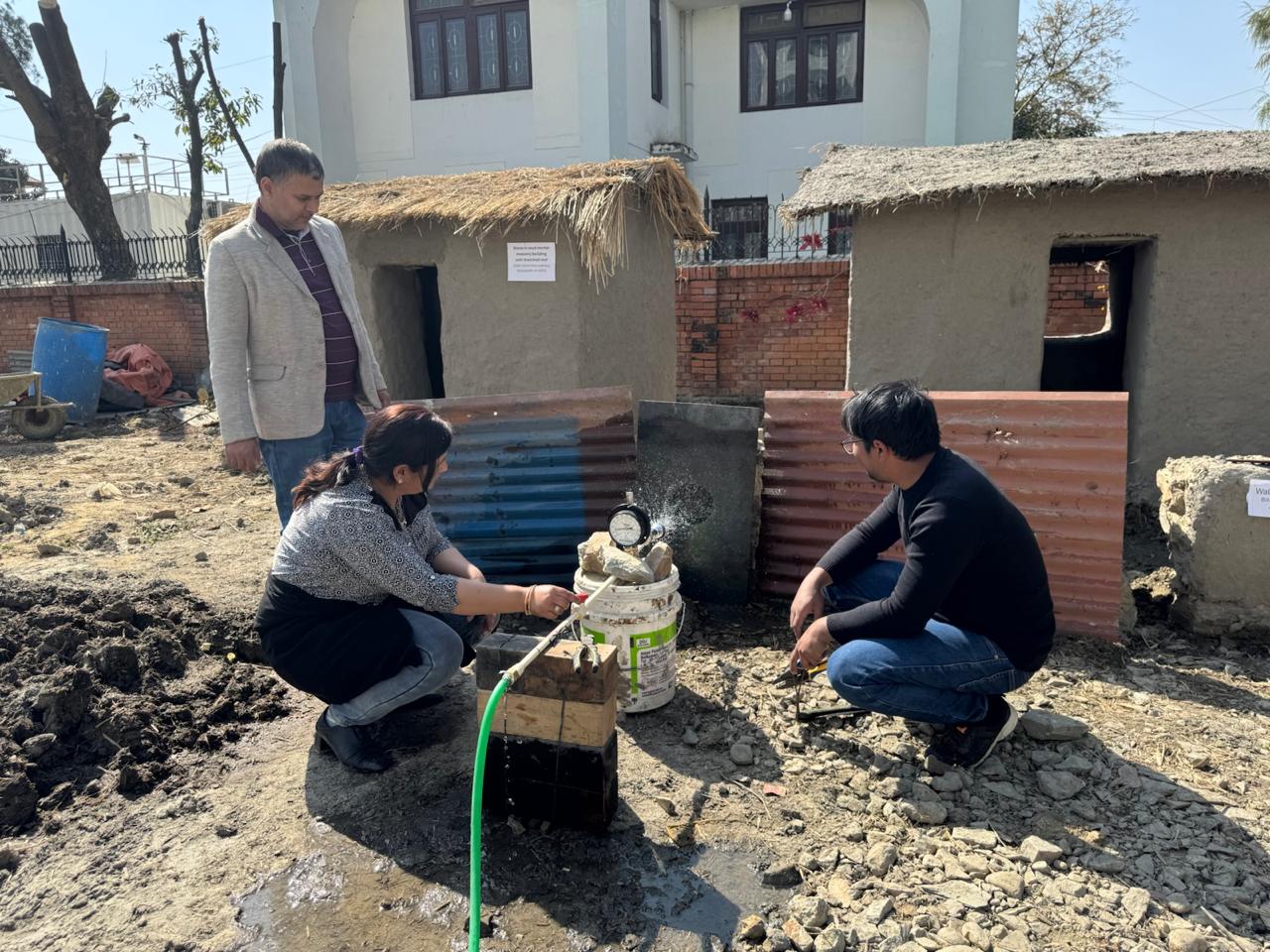
The traditional village house is built using timber and mud mortar, relying on indigenous techniques influenced by past earthquake observations and engineering judgment. Earth, a common and ecofriendly material, is easy to work with and can be used for walls, floors, and roofs, even in advanced designs. Earth buildings have low energy consumption and minimal environmental impact. Non- Erodible Mud (NEM) is a traditional housing solution in South Asia. In the past, mud was commonly used for plastering walls, making roofs, and using clay tiles for roofing in house construction. While cement and steel are popular today for their ease of use, NEM is an earth-based, climate-resilient, simple, cost-effective, and sustainable construction method. It uses mud for walls and roofs, offering a reliable, affordable, and culturally accepted alternative. In this context, National Society for Earthquake Technology Nepal (NSET) with funding support from Nepal Academy of Science and Technology (NAST) is implementing a research project: Nature Based Solution for Climate and Disaster Resilience Buildings: Non-Erodible Mud to enhance climate resilience, fire resistant and earthquake safety.
OBJECTIVES
The proposed objective is based on two major parts:
1. Investigate the properties of NEM to understand its behavior under various environmental conditions.
2. Demonstrate the application and adaptability of NEM through prototype buildings to showcase its effectiveness.
3. Prepare detailed technical guidelines on NEM in building construction including specifications for mix design and construction procedures and develop public awareness materials on its basis.
ACTIVITIVES
Development of the testing scheme of the materials and construction process of NEM buildings:
1. Two half scale (i.e. 50% reduced scale) model buildings of with stone in mud mortar masonry walls and thatched roofs will be constructed: One with NEM plaster and the other with ordinary mud plaster. Then a series of experimental tests will be performed on these models:
a. Test 1 Erosion Test: The two models will be exposed to water sprinklers discharging water at controlled pressure. After a specified time, the depth of erosion in each will be recorded and evaluated.
b. Test 2 Fire Simulation: Fire will be ignited in both the models to simulate fire scenario. The burning intensity will be assessed along with burning time.
2. Both the models will be restored, and the thatched roofs will be replaced with CGI sheets. In one of the model GI wire mesh covered with NEM plaster will be applied. In certain portions of this model, cement plaster will be applied. This is done to evaluate the amount of corrosion of the wire mesh covered with different materials. Then the following tests are conducted on both these models:
a. Test 1 Temperature test: This test is done to evaluate the insulation offered.
b. Test 2 Corrosion Test: The GI wire mesh will be checked after a certain period to check whether they corrode.